

Public lectures remain essential for my mission of preserving, promoting, and publishing Hudson Valley’s local history. The stories I have learned from history’s unexpected events have paved a path inviting audiences to join me as we travel back in time. For more than years, I’ve had the honor of speaking at historical societies, libraries, and regional organizations with a strong record of repeated events at venues as I develop new programs.
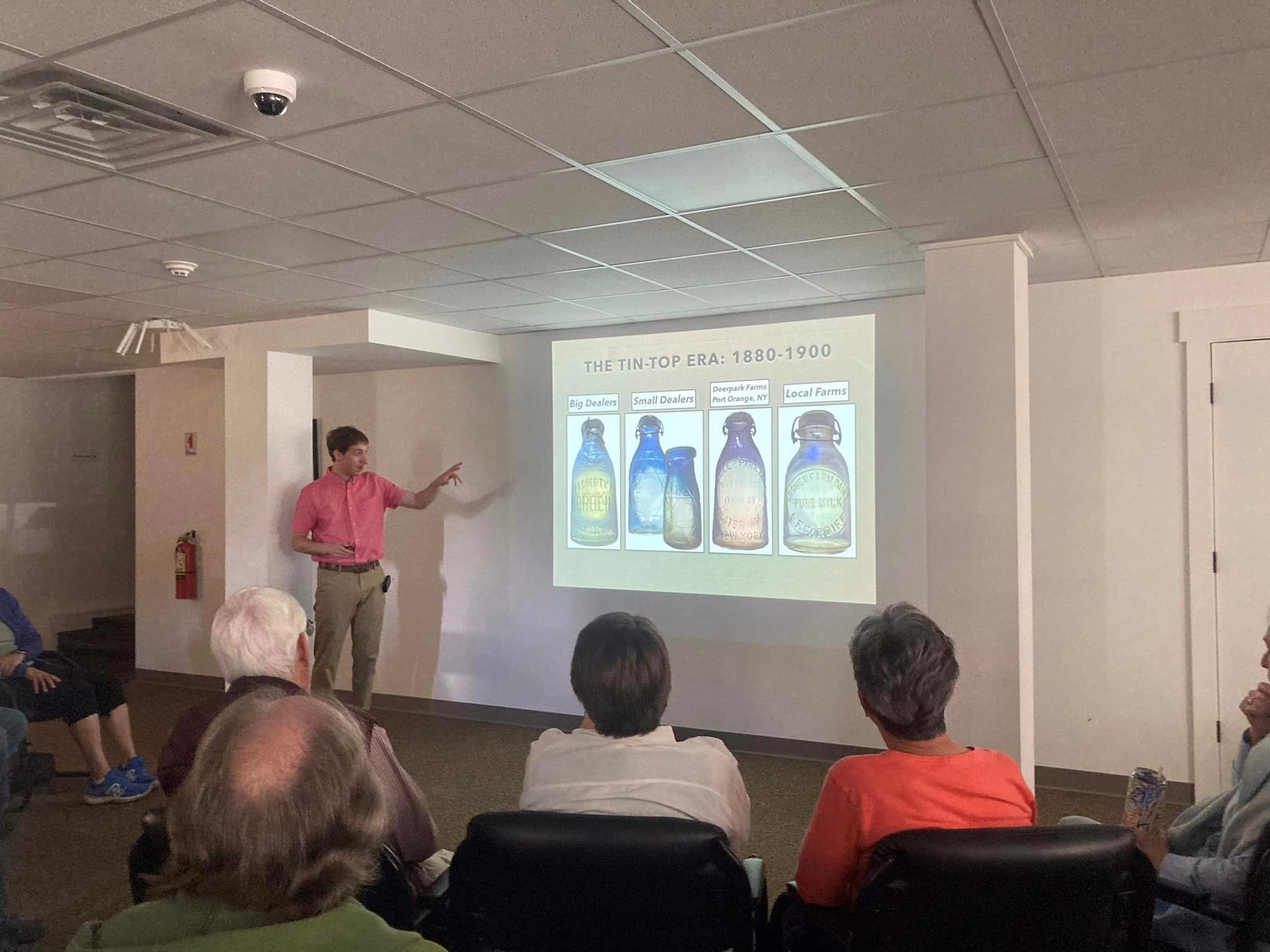
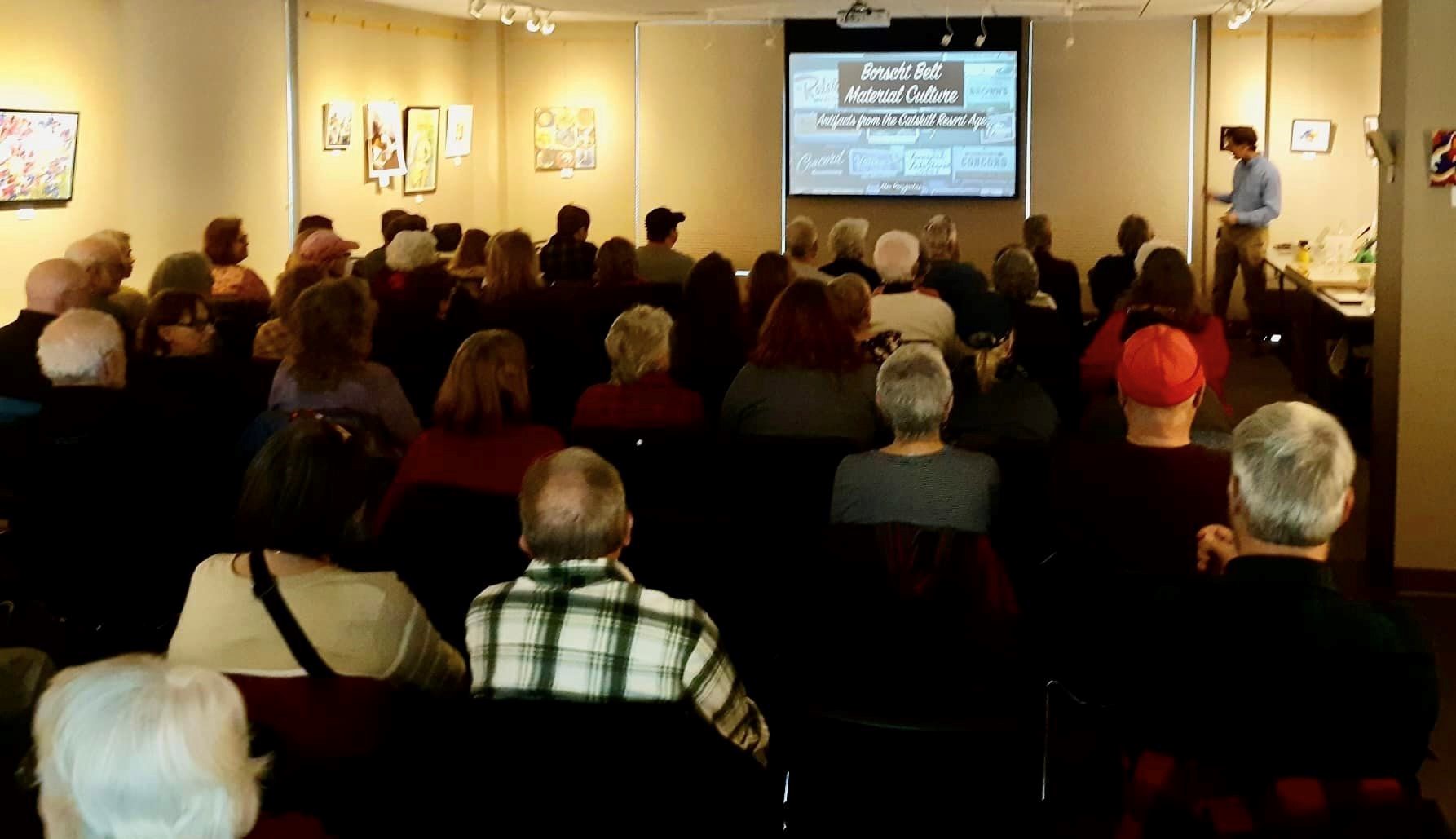
Currently, I have twenty topics available for historical lectures and frequently present throughout the Hudson Valley and northern New Jersey. Each lecture can be presented in person or virtually depending on your specific needs, with high-grade Canon cameras, a condenser microphone, and hard-wired internet allowing for the best quality possible for ZOOM programs. My events often include two facets, beginning with an attractive PowerPoint presentation that has images, period newspaper articles or text, and embedded audio recordings as well as videos. In addition, I showcase artifacts relevant to a particular program. For instance, my program on Orange County’s Dairies and Their Milk Bottles features an array of bottles on display from the Orange County Milk Bottle Museum. One of my more popular programs titled “The Art Of Antique Bottle Detecting” even comes with four crates holding close to 100 bottles that define and help illustrate the various details that help tease out the stories behind identifying antique glass bottles. At each lecture, I bring a display of all my publications that are available for purchase. This bifurcated approach seeks to immerse the audience so they can better understand the past.



Here are some examples of topics that I currently share with the public. Please note that I always have new concepts for lectures in development and enjoy working with organizations that suggest new topics:
New York State/Hudson Valley History Lectures
Borscht Belt Architecture: Designs of the Jewish Alps (New for Fall 2025)
Transitioning from the introductory “Borscht Belt Artifacts” program, this part two program highlights the legacy of interior and exterior architecture that defined the Borscht Belt Catskills. Following the “Silver Age” hotels of Victorian style that defined the late 19th century, new Jewish hotels, bungalow colonies, and growing resorts added their own influences to existing structures. Several movements in architecture, such as Sullivan County Mission Style and Sullivan County Tudor Style designs, gained a popular reputation in the Borscht Belt. Then, in the 1950s, the wave of Mid-Century Modern influences within this region of New York set the tone for hotel designs on a national scale. Using postcards, photographs, images from antique brochures, and modern-day scenes, Prizgintas reveals how this architecture helped to define elements of the quintessential Borscht Belt experience from room design to recreational activities, entertainment, outdoor landscape, and what architecture features can still be seen today.
Borscht Belt Entertainment: The Growth of Comedy and Music (New for 2026)
When someone thinks about the Borscht Belt, perhaps images that first come to mind are comedians like Red Buttons, Alan King, and Jerry Lewis or the rich history of bands that filled nightclubs with walls of sound. The third part of Alex’s Borscht Belt series highlights this rich theme of the Catskill Resort Age, showcasing stories of comedians who got their start in the mountains and some of the music that was also featured there. Attendees can even see selected video and audio clips of comedians and musicians in the Borscht Belt.
Spoiled Milk: A Story of Orange County’s Dairies and Their Milk Bottles
Innovation transformed dairy farming on a national scale in 1842 when a freight train transported milk for the first time by rail from Chester, NY to New York City. From this point, new inventions and developments such as the milk can, milk bottle, and door-to-door delivery of dairy products swiftly evolved in the following decades—all with ties to Orange County, New York. Expanded from the original show “Orange County’s Dairies and Their Milk Bottles,” the audience takes a journey through some of Hudson Valley’s most important dairy farming achievements, the struggles that farmers endured against the wrath of metropolitan milk dealers, and the stories of farms that once populated Orange County. This lecture also comes complete with a display of vintage milk bottles from the Orange County Milk Bottle Museum.
Borscht Belt Artifacts: Relics of the Catskill Resort Age
Culture, cuisine, and comedy came together to form an intricate network of hotels, bungalow colonies, and resorts throughout New York’s Catskill Mountains. With a strong Jewish lineage, the Borscht Belt came to be known as a distinctly American story—one represented by a diverse clientele that journeyed to the mountains in search of fellowship basking under the warmth of the summer sun. Now, with the remaining hotel structures vanishing one by one, it is through these remaining artifacts such as matchbooks, silverware, menus, and even architectural details that this story can be shared. The lecture employs these relics to share with visitors the complete and complicated story of the Borscht Belt—one that extends before the Civil War and reveals the many industries, as well as individuals, that made it successful. Displayed are a wide array of artifacts from the Richard L. Benjamin Archive of Borscht Belt Tourism History, which works in conjunction with the Borscht Belt Museum in contributing artifacts for exhibits.
Houghton Farm: A Monumental Convergence of Agriculture, Art, and Industry in 19th-Century Orange County
What today stands as quiet homes and open fields in the town of Cornwall, NY was once a monumental site of agricultural innovation, artistic creation, and industrial alchemy. Operating from the 1870s to the 1930s, the legacy of Houghton Farm may be best seen in the renowned works of American artist Winslow Homer—who spent many summers on the property. Founded by varnish magnate and founder of the Valspar corporation Lawson Valentine, Houghton Farm’s studies of experimental crops and breeding of high-grade livestock were cutting-edge science and reported nationally in its time. With few remaining traces of the farm today, the lecture draws on the collections housed at the Woodbury Historical Society–the largest repository of Houghton Farm materials.
Landscape Architecture in the Hudson Valley: Frederick Law Olmsted, Calvert Vaux, and Andrew Jackson Downing
This new program for 2025 showcases the rich legacy of Landscape Architecture in southern New York. Highlighting the work of Calvert Vaux, Frederick Law Olmsted, and Andrew Jackson Downing, Prizgintas explored their rise to fame and most famous projects—much of which can be drawn to the city of Newburgh where the three crossed paths for the first times in the 1850s. Adapted from Alex’s 2021 film documentary produced in part with Marist College’s Hudson River Valley Institute, both Olmsted and Vaux remained tied to the Hudson Valley even after their fame with the construction of Central Park—particularly through Vaux’s architectural works and the business of the Olmsted Bros. firm. This program pays particular attention to two landmarks that received influences from both minds: Middletown’s Hillside Cemetery and Newburgh’s Downing Park, Matthew Vassar’s Springside, the Hudson River State Hospital, and other locations across the Hudson Valley.
Luis Moses Gomez: A Story of the Nation’s Oldest Jewish Dwelling
When Sephardic Jewish merchant Luis Moses Gomez first arrived in the new world between 1700 and 1705, he quickly rose as a shrewd and successful businessman on the increasingly-populated Manhattan Island. Spreading his influences northward to the Hudson Valley between 1714 and 1716, his establishment of property near today’s Marlboro, NY marked the site of the nation’s oldest Jewish dwelling—a home that would come to experience more than 300 years of transformation. Using newly discovered documents, Alex’s program identifies popular legends and little-known facts about Gomez, along with the storied history of today’s Gomez Mill House.
Old Orange Houses Revisited: A Then-and-Now Journey of Orange County’s Storied Dwellings
Built upon the 1940s-era work of regional historian Mildred Parker Seese, “Old Orange Houses Revisited” shares the stories of Orange County’s earliest dwellings and their current state since Seese’s prior publications. This program also features added homes at times that were not previously included by Seese, augmented by facts that have since been discovered after its publication in the 1940s as well as a look at some homes that have since been demolished. The selection of homes offered in this program changes and is modified to address the specific region where the lecture is presented.
Riverside Moguls: Wealth and Power in New York’s Hudson Valley: Part One: Rise of Steel Rails
“Riverside Moguls” is a noted three-part series covering the stories of Gilded Age industrialists and their Hudson Valley estates. Looking to offer a balance of well-known and neglected landmarks, part one of this program features individuals with strong ties to railroads, including Jay Gould’s Lyndhurst Estate, J.P. Morgan’s Cragston Estate, William Henry Osborn’s Castle Rock, E.H. Harriman’s Arden House, and the Vanderbilt legacy of Hyde Park.
Riverside Moguls: Wealth and Power in New York’s Hudson Valley: Part Two: Titans of Industry
Building on the theme of part one, Titans of Industry focuses on industrialists tied to other themes of the Gilded Age suchas oil and real estate. Featured in this segment are John D. Rockefeller’s Kykuit Estate, the villas of Robert Wilson Goelet’s Glenmere Estate and Charles E. Rushmore Canmore Estate, Pierre Lorillard IV’s Tuxedo Park, Col. Oliver Hazard Payne’s West Park Estate, and the Livingston Legacy of Staatsburgh.
Riverside Moguls: Wealth and Power in New York’s Hudson Valley: Part Three: Five Sleeping Giants
The latest addition to the Riverside Moguls series takes a focus on five Hudson Valley estates tied to industry which are generally not open to the public and have thus not been subject as much to popular attention. These include Charles Oliver Iselin’s “All View” estate of New Rochelle, Eleazar Lord’s Piermont Castle and the Erie Railroad story, Sloatsburg’s “Table Rock” estate of both Hamilton and Morgan lineage, Margaret Carnegie’s “Migdale” Estate of Millbrook, and the MacKenzie legacy of Sullivan County with Glen Spey’s Burn Brae Estate.
The Rondout Valley’s Glassy Past: The Ellenville Glass Works
Once employing more than 700 workers and shipping its products as far away as Cuba and Germany, the Ellenville Glass Works could be argued as one of both Ulster County and the Hudson Valley’s leading industries. Producing wares ranging from glass bottles to telegraph insulators, pottery, and various forms of artistic glass, what is perhaps most striking is how few, if any, traces of the glassworks remain today.Built from his pivotal article in the peer-reviewed Hudson River Valley Review and drawing from the archives of the Ellenville Public Library & Museum, this lecture uncovers long-forgotten and, in some cases, documents never previously seen by the public to share a glimpse of Ulster County’s nineteenth-century industrial age.
Woodbury: Historic Hotels, Boarding Houses, and Bungalow Colonies of the Hudson Valley’s Lost Resort Destination
Whether it be the Hudson Highlands, vibrant riverfront downtowns, or the Catskill Mountains, the Hudson Valley holds diverse attractions for eager tourists. Perhaps one of the most popular of these attractions is the Woodbury Common Outlet Mall, though the Town of Woodbury boasts a tourist and resort history extending more than a century prior. In the late nineteenth century, the most elaborate hotels in Woodbury boasted electric lighting, telephone service, on-site golf courses, and even guided tours of the region. These flourished decades before the rise of the Borscht Belt resort craze while their amenities were on par with Victorian-era mountain houses of the Catskills. Appealing to populations of wider economic strata in society, smaller boarding houses offered intimate experiences where guests engaged in family chores for the duration of summer seasons—a practice that has become less and less common today. By the 1920s, Woodbury entered a new phase of resort tourism when summer bungalow colonies rose to prominence. A tightly-knit community of these colonies hosted a variety of famed individuals during the twentieth-century, including Nobel Prize winner Leon Lederman, film director Sidney Lumet, and choreographer Jerome Robbins. There’s even evidence suggesting that “the Nanny” (Fran Drescher) once spent her summer at a summer colony in Woodbury.
New York/Hudson Valley Railroad History Lectures
Campbell Hall, NY: The Hudson Valley’s Forgotten Railroad Nexus
What today resides as a rural, picturesque community in Orange County once served as a crucial junction for railroad traffic in the Hudson Valley. Campbell Hall received its first railroad in the 1870s, and for the text three decades, its growth showed no signs of stopping. Soon boasting four railroads, and often receiving traffic from five in its prime, most of Orange County’s long-distance railroad traffic passed either close or inside the boundaries of Campbell Hall. Perhaps most important was the nearby Maybrook Yard, often known as the “Gateway to the East” with its connection to the Poughkeepsie Railroad Bridge and New England. Although Maybrook was the place where trains were sorted for their distant destinations, Campbell Hall served as the “interchange” where these trains passed in either direction, seeing countless, if not hundreds, of trains each week. Today, Campbell Hall still retains an important regional presence for railroading, but its era as a railroad junction has largely vanished—now preserved through maps, documents, and photography.
From City to Country: A Journey along the Erie’s Pine Bush Branch
The Erie Railroad’s Middletown & Crawford Branch to Pine Bush shared the story similar to other Orange County branchlines: a rural single-tracked railroad that proved vital to serving its communities. Opened in the 1870s, it originally had close ties to the New York & Oswego Midland Railroad, later known as the New York, Ontario & Western, before its long-time association with the Erie Railroad after the 1880s. This program explores the history of train travel to Pine Bush, including the communities of Middletown, Fair Oaks, Circleville, Bullville, and Thompson Ridge, from 1872 until the rails were abandoned in 1978.
Rails to the River: The Story of Newburgh’s First Railroad
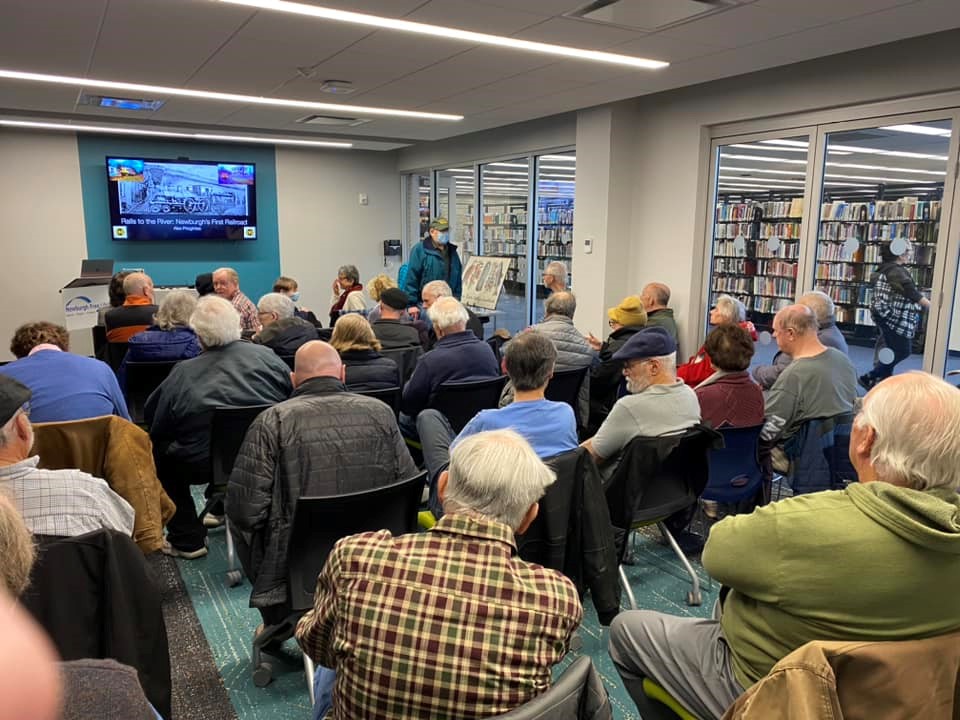
The city of Newburgh, NY has long held importance for Hudson River trade, so some may find it fascinating that this economic outlet was placed in jeopardy during the 1830s. Until 1828, the city sat well-positioned with a network of roads linking Orange County, New Jersey, and Pennsylvania to the waterfront port. However, when the Delaware & Hudson Canal opened Rondout at Kingston as a new source of trade, Newburgh fought hard for its connection to the nation’s growing railroad industry. It would take twenty years from that point for the Erie Railroad’s Newburgh Branch, the city’s first railroad, to answer this need. From 1850 through 1979, the Newburgh Branch served the communities of Craigville, Blooming Grove, Washingtonville, Salisbury Mills, Vails Gate, and New Windsor—making it one of the longest-operating railroads in Orange County’s history.
Iron Strikes Twice: The Erie Railroad’s Newburgh Shortcut and the Fight to Enhance Newburgh’s Railroad Network
While Newburgh earned its first railroad in 1850, all was not ideal. The Erie Railroad’s Newburgh Branch was effective but constructed in such a way that trains had to take a detour of nearly twenty miles around Schunnemunk Mountain. Designed to be a part two for “Rails to the River,” this program covers the story of Newburgh’s second railroad, the Erie Railroad’s Newburgh “Shortcut,” and the towns that it served including Central Valley, Highland Mills, Woodbury Falls, Houghton Farm, Mountainville, West Cornwall, and Vails Gate.
Stone Arches, Rock Cuts, and a Trip to the Summit: E.H. Harriman’s Incline Railroad
The Hudson Valley was once home to three inclined railroads, with most operating to bring tourists to some of the region’s highest points and scenic views. Only one of these railroads, however, was used in the construction of a Gilded-Age estate on par with the Rockefeller’s, Goulds, and Vanderbilts of this era and remained in operation for nearly forty years as perhaps the only true “private” railroad in the Hudson Valley. A multi-faceted lecture, listeners are treated to an overview of the life of railroad mogul Edward Henry Harriman, his journey to Orange County, NY in 1886, and the construction of Arden House which facilitated his incline railway.
The Water Level Route: How Trains Crossed the Hudson River by Barge from Newburgh to Fishkill Landing
Before the opening of the Poughkeepsie Railway Bridge in 1889, train cars, much like people or vehicles of later time, crossed the Hudson River on barges. A true east-west connection from New England to the Hudson Valley had been attempted countless times since the 1860s, and when the New York & New England succeeded with one of the most efficient routes in the 1880s, it debuted a marvel of engineering on the Hudson: the William T. Hart. A “car-float” ferry said to be the largest of its kind capable of transporting both railroad cars and passengers, tracing its history shows a unique glimpse of how traffic moved across the Hudson before the era of bridges.
Through Bailey’s Lens: A Two-Part Series of Orange County’s Railroading through the 1909 Photographs of James E. Bailey
This two-part series highlights the photographs of James E. Bailey, an Erie Railroad employee who, in 1909, was tasked with photographing every Erie Railroad station between Jersey City and Chicago. His glass plate negatives with exceptionally crisp resolution provide unique glimpses into what everyday life was like in Orange County more than 110 years ago. In addition, this program combines precise modern-day photographs with the early images to reveal then-and-now transformations.
General History Lectures
Preserving Tomorrow’s History: An Analysis of the Strengths and Challenges Facing Today’s Regional Historical Societies and Techniques for Enhanced Community Engagement
Historical societies are among a community’s most important source for all things of the past, while also being an important facet of allowing one to become more mindful and knowledgable of their communities. Ranging from declining involvement in nonprofit groups to the lingering effects of the COVID-19 pandemic on social atmospheres, historical societies now face many challenges amidst a myriad of opportunities for growth. With an emphasis on the Hudson Valley and Orange County, New York, Alex Prizgintas takes attendees on a historical tour of the “history” of the region’s historic preservation campaigns, the current challenges that face historical societies, and what can be done to craft new avenues of growth for these organizations. Having studied these groups for more than ten years, both before and after the effects of the COVID-19 pandemic, Alex combines research with real-life observations
The Art of Antique Bottle Detecting
Antique glass is one of the most unique relics. Where some collectibles, like toy trains or model cars, were made with the intent of being treasured for decades, much of the nation’s antique glass bottles had a utilitarian purpose for the general public. Whether it was to store food products, soda, ink, or another kind of household product, once its use was complete, the bottle was discarded. Lost to time and often dug from the early trash pits where they were thrown away, these glass vessels often yield many characteristics on the time in which they were made—times that can extend back several centuries. It’s kind of like a scavenger hunt, which lends a unique thrill to this hobby. Alex and Viktor Prizgintas touch on this theme in “The Art of Antique Bottle Detecting,” combining a PowerPoint program with a display of more than sixty antique bottles—some of which are more than 200 years old. Using these tools, attendees are guided through eighteen questions to help identify the characteristics of glass bottles. “A computer screen only shows so much, the genuine artifacts have so much to share with the audience. We also encourage those attending to bring any bottles they have, perhaps in their basement, kitchen, or attic hideaway. We always enjoy sharing some knowledge and having the satisfaction that our audience walks away learning a little bit of history” says Alex.
Please see the following videos for information on some of my presentations:
Orange County’s Dairies and Their Milk Bottles
Join me as I uncover Orange County, New York’s role in the American consumer use of fluid milk. Where many may speculate that these dairy products were solely popular due to the region’s superior agricultural landscape, history has instead shown that Orange County stood at the forefront of transporting and marketing fluid milk in the nineteenth century. Individuals instrumental in this creamy saga, from Erie Railroad station agent Thaddeus Selleck who first shipped milk by rail in 1842 to milk can pioneer Jacob Vail and the early milk bottle user Alexander Campbell all either were situated or had close connections to Orange County. The results of their efforts gave birth to the golden age of Orange County’s agriculture–one that fueled over 4,000 farms of all kinds by 1884 and kept dairy farms prospering into the mid-twentieth century. I am a graduate of Marist College in Poughkeepsie, NY where I studied Hudson River Valley History. A life-long resident of Orange County, I give more than thirty programs over the past eight years in the tri-state area on various genres of local industrial history. Additionally, I have published on topics covering Orange County’s dairy industry, local railroad lines, and the Ellenville Glass Works.
The Art of Antique Bottle Detecting with Alex & Viktor Prizgintas
Have you ever come across that lone bottle residing on your kitchen shelf or living room counter begging to tell a story? Today, it is often forgotten how glass bottles were once a primary method of storing and transporting substances of all kinds. Join Alex and Viktor Prizgintas as they discuss the fundamentals behind dating and identifying antique bottles. Alex has been collecting bottles from the Hudson Valley for over ten years and served as president of the Hudson Valley Bottle Club from 2018 to 2020. His research on local bottles and bottle history has been published in the Antique Bottle & Glass Collector magazine as well as Marist College’s Hudson River Valley Review journal. “Alex and Viktor Prizingtas truly know how to tease the story out of a bottle,” says Diane Lapis, president of the Beacon Historical Society where this lecture was presented in March of 2022. “The Art of Bottle Detecting helps the viewer to understand markings on bottles and put them into historical context. You will never look at a bottle in the same way again: marks, dips, seams, and colors come alive after this succinct and interesting discussion.”
Luis Moses Gomez: Three Centuries of History in New York’s Hudson Valley
The Hudson Valley fostered numerous celebrated events in history, but one era of transformation is often overlooked. Contrasting the region’s seventeenth-century settlements which were defined by ethnic, religious, and cultural identities, the eighteenth-century market revolution influenced these communities with evolving commercial forces. The development of transportation on the Hudson River and the growth of New York City as a center of trade linked local residents to the burgeoning Atlantic market. Regional farmers and artisans, however, often lacked the finances and influence to become directly engaged in these lucrative ventures, so instead, they consigned their wares through well-established intermediary merchants. One of these businessmen was Luis Moses Gomez, a Jewish refugee who was a member of New York City’s Shearith Israel congregation. Expanding his business interests northward in 1716, Gomez purchased land in Marlboro, New York, where he occupied this important intermediary role between local residents and the expanding market revolution. Gomez’s position in this changing society, as well as the three centuries of history endured by his Hudson Valley property known today as the Gomez Mill House, are extraordinary lenses through which socioeconomic and cultural advancements in the Hudson Valley can be observed.
If you wish to book me for a local history lecture or are wondering if I present on a specific topic, please fill out the information below and I will respond at my earliest convenience:


 Hello. I'm Alex.